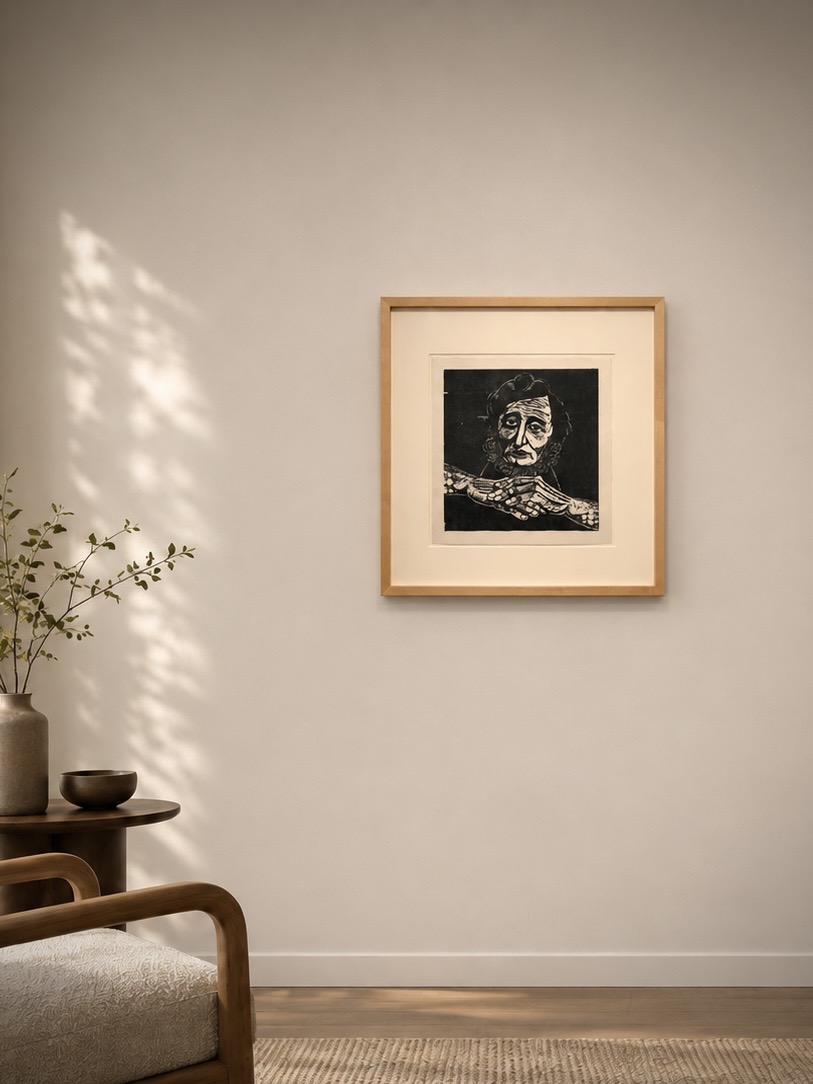
Solitude (1971) is a limited-edition portfolio of eleven original woodcuts by Japanese artist Naoko Matsubara (松原直子), created in response to the chapter "Solitude" from Henry David Thoreau's Walden (1854). Published by Aquarius Press in Baltimore and New York, the portfolio brings together Matsubara's expressive woodblock prints and Thoreau's reflections on nature, solitude, and independent living.
Created during Matsubara's years in New England, the series emerged from her repeated visits to Walden Pond in Concord, Massachusetts. Over the course of a year, she observed the landscape and its changing seasons, translating these experiences into a body of woodcuts that moves between direct observation and personal interpretation.
Solitude and Walden Pond
Henry David Thoreau lived near Walden Pond from 1845 to 1847, an experience that became the foundation of his book Walden, published in 1854. His experiment in deliberate living explored the relationship between the individual, society, nature, and material necessity.
More than a century later, Matsubara returned to the same landscape as a source of artistic inspiration. Portland Art Museum documents that she created the Solitude portfolio while visiting Walden Pond over the course of a year.
Her woodcuts explore the changing character of the natural environment through trees, water, wind, rain, and seasonal transitions. The portfolio includes images of a solitary willow, winter landscapes, decaying wood, and the presence of Thoreau himself.
Rather than illustrating the literary text literally, Matsubara gives visual form to an experience of solitude that can be contemplative, unsettling, and deeply connected to the natural world.
The Portfolio and Its Publication
Solitude: An Essay from Walden by Henry David Thoreau, 11 Woodcuts by Naoko Matsubara was published by Aquarius Press in 1971.
The portfolio consists of eleven woodcut prints, an accompanying letterpress booklet containing Thoreau's text, and a woodcut-printed cover or portfolio case. The works combine color and monochrome printing, demonstrating Matsubara's energetic carving and distinctive treatment of organic forms.
The eleven principal prints are titled Solitude, Decaying Beauty, Rain, Winter Serenity, Winter Pond, Autumn Color, Wind, Pine, Spring Visitor, Thoreau, and Drop of Life. The woodcut associated with the portfolio cover is titled Walden Pond.
The standard portfolio was issued in a limited edition of 200. Bibliographic descriptions distinguish the eleven principal prints from additional woodcut elements used in the cover and accompanying booklet. These components form part of the publication's identity as both a print portfolio and an artist's book.
Museum Collections and Institutional Context
Works from Solitude are represented in several institutional collections, including the Portland Art Museum, the National Museum of Asian Art at the Smithsonian Institution, the National Museum of Modern Art, Kyoto, and the Pennsylvania Academy of the Fine Arts.
The Los Angeles County Museum of Art also holds bibliographic and collection records for the portfolio and its printed components.
The National Museum of Modern Art, Kyoto, records individual prints from the series under the Japanese title 寂寥, with acquisition records dating to 1973. These institutional holdings establish the portfolio's presence within both Japanese and North American collections of modern and contemporary printmaking.
Matsubara's continuing significance was also recognized by the Museum of Fine Arts, Boston, in its 2026 exhibition Naoko Matsubara's Woodblock Worlds, which explores the places and experiences that shaped her artistic practice, including Boston and the surrounding region.
Collector's Note — Walden and the Meaning of Solitude
Since moving to Boston, I have visited Walden Pond many times. I have even tried fishing there, although I have never managed to catch a fish. What continues to bring me back is not the prospect of a successful catch, but the quiet and distinctive atmosphere of the place.
I also recently visited Henry David Thoreau's grave in Concord. Walking along the shore of Walden Pond and standing before his grave prompted me to reflect on the relationship between solitude and the way I have chosen to live.
I sometimes describe myself as a "professional hikikomori." For me, it is a deliberate experiment in how far I can pursue a life shaped by solitude, independence, and distance from the expectations of society. I do not regard solitude simply as withdrawal, but as a way of observing the world and listening more carefully to my own thoughts.
Knowing that Matsubara had repeatedly visited Walden Pond while developing Solitude gave the portfolio a particular significance for me. Her artistic response to a landscape I had come to know personally created a connection between the work, its literary origins, and my own experience.
After spending time at Walden Pond, visiting Thoreau's grave, and encountering Matsubara's work at the Museum of Fine Arts, Boston, discovering Solitude felt like the convergence of several experiences that had previously seemed unrelated.
For this reason, Solitude holds a special place in the DCOMA Collection. It is not only a remarkable example of Japanese woodblock printmaking, but also a work through which art, place, and personal philosophy meet.
Artwork Details
Full Title: Solitude: An Essay from Walden by Henry David Thoreau, 11 Woodcuts by Naoko Matsubara
Japanese Title: 寂寥(せきりょう/じゃくりょう)
Publisher: Aquarius Press, Baltimore and New York
Publication Year: 1971
Work Type: Limited-edition woodcut portfolio / artist's book
Portfolio Contents: Eleven principal woodcut prints, accompanying letterpress booklet, and woodcut-printed cover
Edition: 200 (standard portfolio edition)
Literary Source: Henry David Thoreau, Walden (1854), "Solitude"
Place of Artistic Inspiration: Walden Pond, Concord, Massachusetts, USA
References & Links
- Naoko Matsubara — Official Publications Archive
- Portland Art Museum — Matsubara Naoko and Solitude
- Los Angeles County Museum of Art — Solitude (1971), Collection Record
- Art Platform Japan — Naoko Matsubara, National Museum Collections
- Smithsonian National Museum of Asian Art — Decaying Beauty, from the portfolio Solitude (1971)
- Pennsylvania Academy of the Fine Arts — Wind for Solitude (1971)
- Museum of Fine Arts, Boston — Naoko Matsubara's Woodblock Worlds (2026–2027)